We’re excited to announce our latest paper, now published in Environmental DNA, “Optimizing eDNA Replication for Standardized Application in Lotic Systems in Aotearoa, New Zealand.” The study, led by Josh Smith at Waikato Regional Council, addresses the ongoing challenge of standardising environmental DNA (eDNA) sampling protocols across New Zealand’s freshwater systems.
Why Standardised Sampling Matters
With eDNA emerging as a powerful tool for biodiversity monitoring, we saw an opportunity to align freshwater sampling methods prior to the broad-scale adoption of eDNA into our national state-of-environment monitoring and reporting system. By refining our collective approach now, we can ensure that future data collection is consistent, comparable and cost-effective across the country.
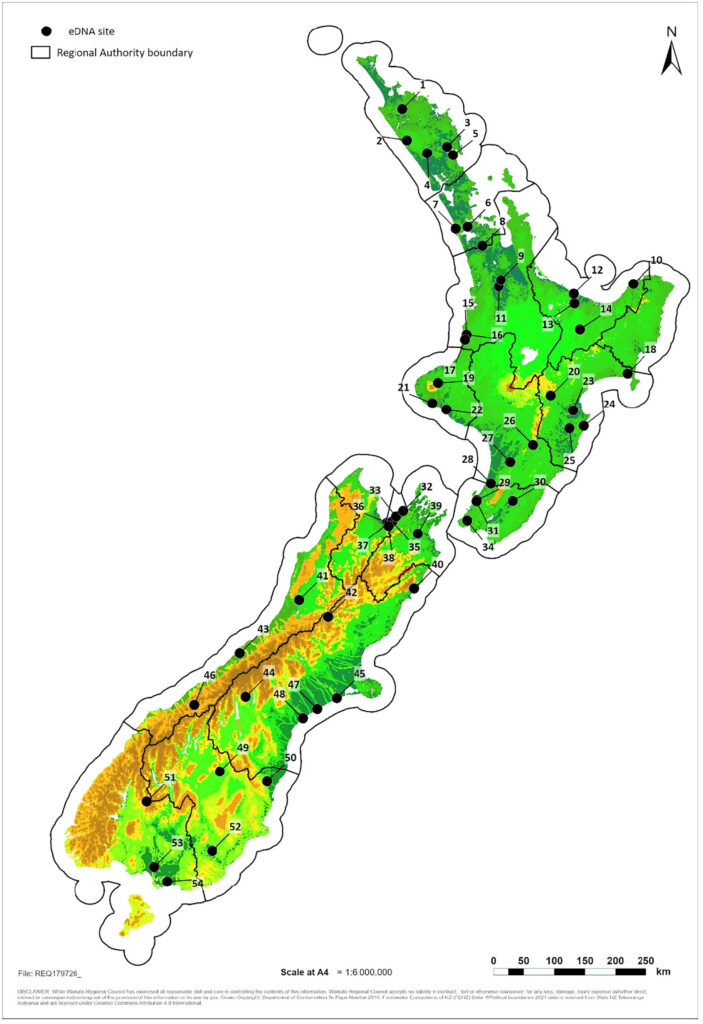
Because eDNA in water can be unevenly distributed and at varying stages of degradation, insufficient replicate samples can lead to false negatives (non-detection of present species). On the other hand, higher replication can drive up costs and increase the risk of false positives due to contamination. By analysing the data from 54 river sites across the country, the study aimed to determine the optimal number of replicates to strike the right balance between accuracy and cost.
Key Findings
The study uncovered several important insights for optimising eDNA sampling:
- Replication Matters: Six eDNA replicates consistently detected approximately 90% of fish species and 86% of macroinvertebrates across 54 river sites.
- Balancing Cost and Accuracy: Results showed diminishing returns beyond six replicates, indicating that six-replicate sampling offers a practical trade-off between biodiversity characterization and cost-efficiency.
- Location-Specific Insights: Species richness for fish varied with altitude, suggesting the need for location-specific considerations in national protocols.
What’s Next
This research plays a key role in establishing national eDNA monitoring standards, supporting consistent and effective biodiversity monitoring across New Zealand’s freshwater systems. A standardised national approach will also help with the development of ecosystem health indices and benchmarks.
The findings have already been incorporated into this set of guidelines published by NIWA. This comprehensive reference manual provides an essential resource for eDNA beginners and experienced practitioners alike, aiming to ensure uniformity across eDNA sampling efforts nationwide.
Special thanks to everyone else involved in this work, including New Zealand’s regional and district councils, Department of Conservation (DOC) and Ministry for the Environment | Manatū mō te Taiao staff, and supporting researchers/academics from The University of Waikato and beyond.
We look forward to seeing these findings advance standardised and cost-effective monitoring, leading to improved environmental outcomes for Aotearoa New Zealand.