Estuaries are among the most valuable and vulnerable ecosystems, providing habitat, food resources, and nursery grounds for a wide range of species. Urbanisation places increasing pressure on these environments, making it essential to have monitoring tools that can capture ecological change across many branches of the tree of life. This study examined how environmental DNA (eDNA) detections relate to long-term water quality conditions in the Gold Coast Broadwater Estuary in Queensland, Australia.
Researchers collected biodiversity data using tree-of-life metabarcoding (ToL-metabarcoding) and compared it with key water quality indicators at eight sites that ranged from relatively healthy to highly degraded. The water quality information included chlorophyll a, turbidity, dissolved oxygen, and total nitrogen and phosphorus, summarised into a Water Quality Index (WQI) ranking.
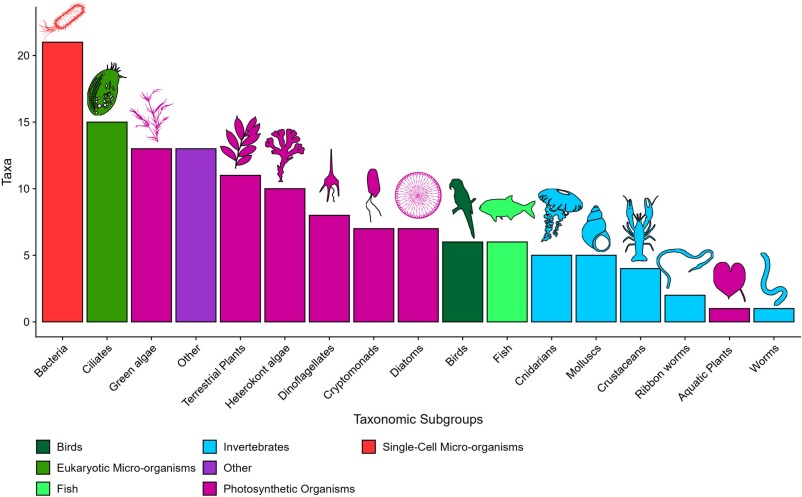
Across the estuary, the team detected 787 unique taxa, including 137 species not previously recorded in the region. Most of these were microorganisms such as bacteria, diatoms, dinoflagellates, ciliates, and cryptomonads. Sites with poorer WQI scores tended to have higher turbidity, elevated nutrients, and lower oxygen levels, and these conditions were associated with greater diversity of bacteria, green algae, and ciliates. In contrast, differences in community composition among vertebrates were less pronounced.
The study shows that broad-scale metabarcoding can act as an effective indicator of estuarine condition, especially for microorganisms that respond quickly to environmental change. This approach provides a rapid, non-invasive way to link biodiversity patterns with water quality, supporting better assessment and management of estuaries impacted by urban development.
Read the full paper here.