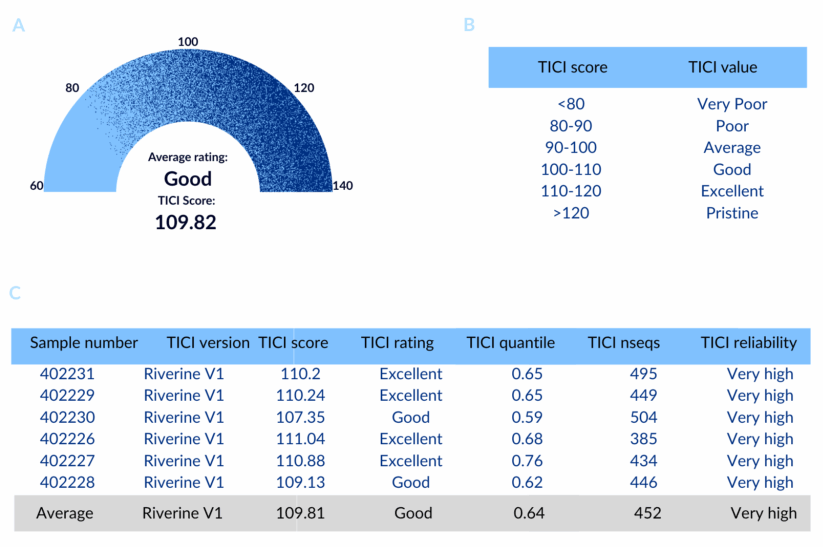
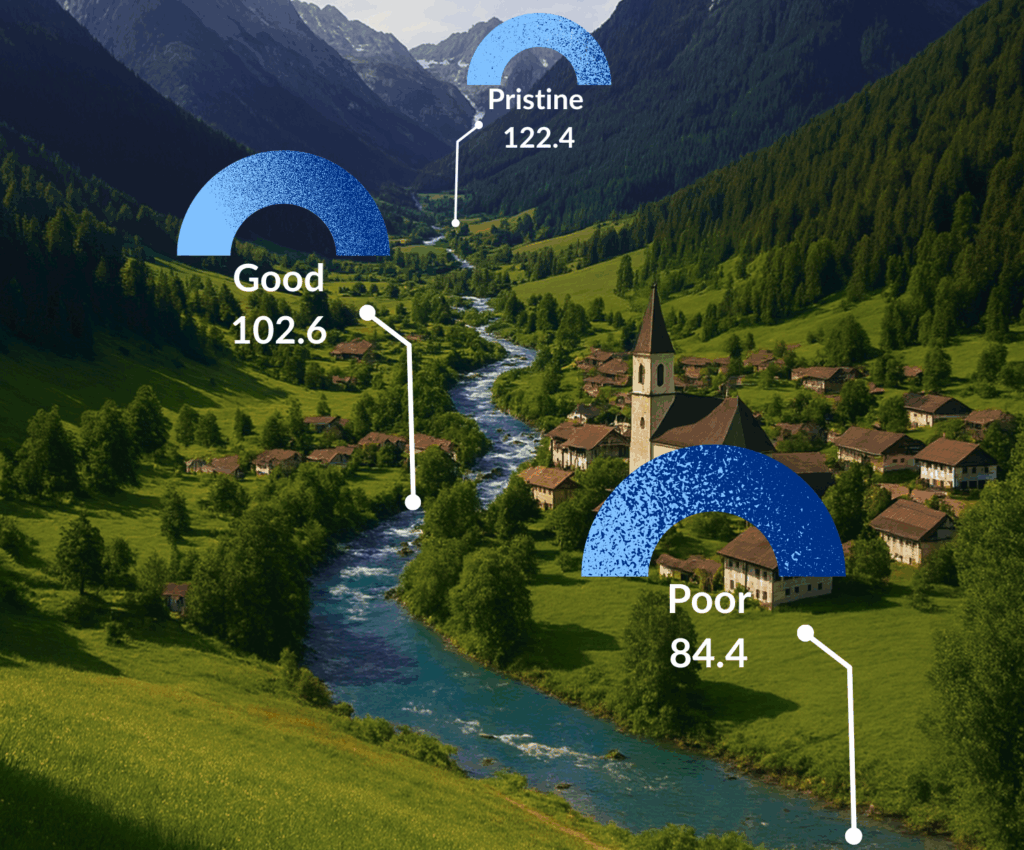
TICI is a novel ecological health index developed by Wilderlab in partnership with New Zealand’s regional councils. It uses environmental DNA (eDNA) and machine learning to assess whole-ecosystem health without depending on taxonomic identification of specific species. This approach provides a more comprehensive and unbiased view of biodiversity, including many organisms that traditional methods often miss.
How the TICI was developed
Between 2020 and 2021, 53 river and stream sites across New Zealand were extensively sampled using eDNA metabarcoding assays. A total of 848 samples were analysed, focusing on the 3,000 most common DNA sequences, which were assigned indicator values through a novel ranking process. Unlike conventional methods that focus solely on macroinvertebrates or fish, TICI assigns scores directly to DNA sequences, capturing a wide range of taxa.
Validation and performance
TICI scores strongly correlate with the established Macroinvertebrate Community Index (MCI), confirming its accuracy in reflecting ecological health. Analysis also demonstrated that TICI effectively detects the impact of land use—such as urban development and agriculture—particularly within 2 km upstream of sampling sites, highlighting its sensitivity to local environmental pressures.
Current application
Since mid-2022, Wilderlab has included TICI scoring as part of its standard freshwater eDNA testing services. This enables clients to monitor river health efficiently and make informed conservation decisions based on robust, data-driven insights. Our ISO17025 accreditation covers TICI reporting in New Zealand riverine environments, and we are working to establish and accredit new TICI metrics in other regions and environment types.
TICI applies to New Zealand freshwater only.
TICI publication
Wilkinson SP, Gault AA, Welsh SA, Smith JP, David BO, Hicks AS, Fake DR, Suren AM, Shaffer MR, Jarman SN, Bunce M (2024). TICI: a taxon-independent community index for eDNA-based ecological health assessment. PeerJ.