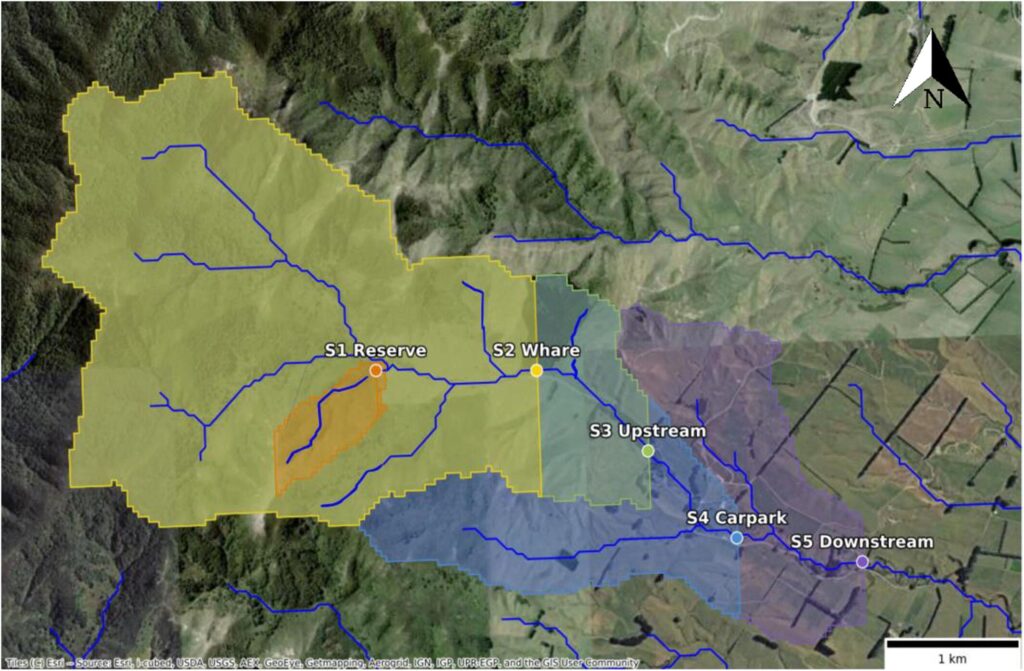
Along the upper reaches of a river that winds from native bush into farmland, local communities and mana whenua (people of the land/tribal authority) came together to understand how their waterway was changing and what it meant for the taonga (treasured) species that depend on it. Using environmental DNA (eDNA) metabarcoding alongside traditional water quality measurements, the research team worked with these partners to build a holistic picture of freshwater health across a 3.5 km stretch of river that transitions from native forest through sheep and beef farming and into an organic dairy farm.
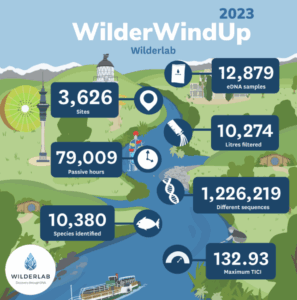
By combining 13 tree-of-life metabarcoding assays with 11 physicochemical attributes, the study detected 479 species, including culturally significant taonga (treasured) species such as whīo (native blue duck), longfin and shortfin tuna (eels), kaharore bully, kōkopu, and kōura (freshwater crayfish). The team also explored fecal contamination patterns. While E. coli levels did not differ significantly among sites, eDNA sequence counts of cattle and deer strongly predicted where contamination sources were likely located, showing that eDNA can reveal patterns missed by conventional indicators.
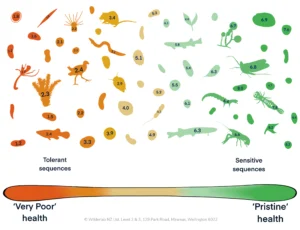
Ecological health was assessed using the Taxon-Independent Community Index (TICI), which showed a strong relationship with water quality attributes (Adj-R² = 0.92) and detected subtle declines associated with increased pastoral land use. These findings highlight how eDNA and TICI can reveal nuanced ecological changes across short spatial scales.
A key strength of the work was its collaborative, community-led design. Local stakeholders—including mana whenua (people of the land/tribal authority) and farmers—took part in sampling, interpreting results, and discussing implications for river stewardship. This shared approach deepened community connection to the river and strengthened collective kaitiakitanga (environmental guardianship). Through active participation and capacity building, the project supported not only regulatory monitoring but also revitalisation of the river’s mauri (life force) and long-term conservation outcomes.
Read the full paper here.